- 16303 Hwy 99 Ste B-2, Lynnwood, WA 98087
- Call Us: 425-737-7760
- Hours: Mon - Fri 8am - 6pm / Sat - Sun 9am - 5pm
Gutters typically overflow due to three primary issues: simple debris clogs, structural sagging/improper pitch, or downspouts that are undersized for local rainfall volume. While many homeowners assume an overflow means they need a brand-new roof, it is often an isolated drainage failure. Gutter guards can significantly reduce maintenance, but they are not a catch-all cure—choosing the wrong style for your specific tree canopy can actually make overflows worse.
For homeowners navigating heavy seasonal downpours across Lynnwood, Everett, Edmonds, Mukilteo, and the rest of Snohomish and King County, a properly calibrated gutter system is your home’s primary defense against foundation damage. Skilled Roofing offers a comprehensive water management inspection to pinpoint why your system is failing and provide a straightforward, lasting fix.
Before investing in new equipment, it is critical to diagnose exactly why your gutters are failing. Use this diagnostic matrix to match what you are seeing from the ground with its technical root cause.
|
Visible Gutter Symptom
|
Common Technical Root Cause
|
Long-Term Solution
|
|---|---|---|
|
Water spilling directly over the front edge
|
Heavy debris accumulation or a severe downspout blockage.
|
Professional clearing or micro-mesh gutter guards.
|
|
Water trickling behind the gutter down the fascia board
|
Damaged, missing, or improperly installed roof drip edge.
|
Drip edge retrofitting and gutter re-securing.
|
|
Pooling water in the middle of a gutter run
|
Loose hangers causing the gutter to sag, ruining the pitch.
|
Re-pitching the run and upgrading to heavy-duty internal hangers.
|
|
Gutters pulling completely away from the roofline
|
Rotted fascia wood caused by long-term moisture exposure.
|
Fascia board replacement and structural gutter re-installation.
|
|
Water overflowing only during extreme downpours
|
Gutters or downspouts are undersized for the roof's surface area.
|
Upgrading from standard 5-inch to high-capacity 6-inch seamless gutters.
|

Many homeowners view overflowing gutters as a minor inconvenience—a nuisance that requires walking through a sheet of water at the front door. In reality, a failing gutter system is an active threat to your entire property. When water does not flow smoothly away from your home, it yields destructive paths of least resistance.

When hundreds of gallons of water cascade over the edge of a blocked gutter, it drops directly onto the soil surrounding your foundation. Over time, this concentrated water saturates the earth, building massive hydrostatic pressure against your basement or crawlspace walls. This leads to foundation cracking, basement flooding, and costly structural shifting.
When a gutter clogs, water backs up and fills the aluminum trough. This standing water constantly submerges the wooden fascia board mounted behind it. If the roof lacks a proper metal drip edge, the water wicks backward into the wooden rafter tails, creating hidden rot that compromises the structural edge of your roof deck.
Continuous spilling quickly destroys expensive landscaping, washes away mulch, and undermines walkways or driveways. In freezing Western Washington winter conditions, this localized pooling transforms concrete driveways and entry steps into severe slip hazards.

Standard residential construction historically relied on 5-inch K-style gutters paired with 2×3-inch downspouts. While this configuration handles moderate weather completely fine, it frequently struggles against the sustained, heavy atmospheric river events common to Western Washington.
Upgrading to a 6-inch seamless aluminum gutter system drastically increases water management safety margins:

Gutter guards are a highly effective tool to prevent clogs, but the industry is flooded with marketing myths. No gutter guard is completely maintenance-free. Every system requires occasional surface clearing, and choosing the wrong type for your specific tree environment can cause immediate failure.
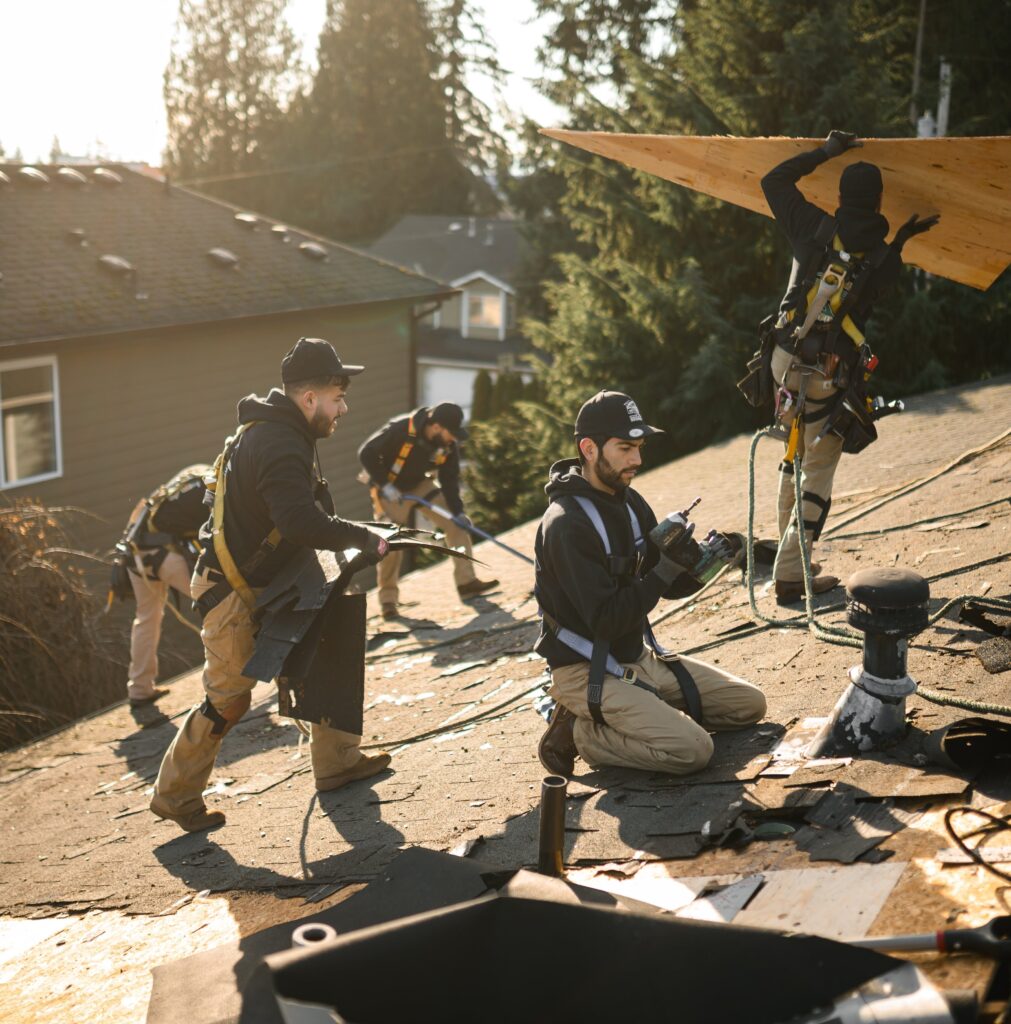


Your gutters do not operate in isolation. They are the final element of an integrated system that includes your shingles, underlayment, fascia, and roof ventilation.
During the winter months, poor system integration causes a destructive phenomenon known as ice dams. When warm air escapes an under-insulated attic, it melts the snow on the upper sections of the roof. As that meltwater runs down to the cold eaves and uninsulated gutters, it refreezes, creating a thick block of ice.
If your gutters are filled with frozen debris, the backed-up water has nowhere to go. It backs up under the lower shingle courses, penetrating the roof deck and leaking into the home’s interior walls. A clean, properly aligned gutter system coupled with a professional metal drip edge is vital to ensuring winter meltwater drains safely away.
Yes, absolutely. Gutters are mounted directly to the vertical fascia board just beneath the roofline, meaning they can be removed and upgraded at any time without disturbing your existing shingles. However, if your roof is over 20 years old and nearing the end of its life, it is often more cost-effective to replace them together to ensure the new metal drip edge integrates perfectly with the new gutter system.
Even with premium micro-mesh guards, you should plan on a quick visual check twice a year. While debris won’t get inside the gutters, heavy, wet tree sap, pine needles, or maple seed pods can occasionally accumulate on top of the screens in deeply shaded areas, requiring a quick brush-off to maintain optimal water filtration.
Loud dripping noises usually occur when water drops from the upper roof valley directly into the downspout elbow below. This can easily be dampened by adjusting the angle of the downspout or installing internal downspout pads. If you hear a rhythmic ticking noise, it is typically just the natural thermal expansion and contraction of the aluminum sections as the outside temperature shifts.
No. Gutter guards do not prevent ice dams because they cannot stop snow from melting on a warm roof and refreezing at the cold eave line. However, they do ensure that when the ice begins to melt, the drainage channels are clear of organic debris, allowing the liquid water to escape instantly instead of backing up into the structure.
Fixing an overflowing gutter isn’t always as simple as scoop-cleaning the debris. If the real issue is a subtle structural sag, incorrect slope calculation, or rotted wood hidden behind the aluminum, a simple cleaning or DIY guard installation will not solve the underlying problem.
Skilled Roofing has provided comprehensive water management and exterior architectural solutions across Snohomish and King County for over 16 years. As a GAF-certified contractor, NRCA member, and BBB-accredited business recognized with the 2026 Excellence in Roofing Award, we assess your home’s entire water diversion system—from the shingles down to the downspout extensions. We deliver honest, permanent recommendations to keep your foundation dry and your roof line secure.
Stop water from damaging your home’s foundation.
"*" indicates required fields