You can learn quite a bit about a roof without ever setting foot on it.
After a rainy week in Lynnwood, stand back from the house and look at the roof. One side may already be dry while another still looks damp. You might see fir needles caught behind the chimney, a green patch beginning near the gutter, or leaves packed into a valley. None of this looks particularly dramatic. That’s partly why it gets overlooked.
Roof buildup usually happens a little at a time.
For homeowners, roof cleaning in Lynnwood is less about keeping shingles spotless and more about keeping an eye on the places where moisture and debris tend to linger. A few regular checks can tell you when the roof simply needs maintenance and when something deserves a roofer’s attention.
First, Take a Walk Around the House
Don’t get the ladder out yet.
Walk around the property and look at the roof from different angles. If you have photos from last year, pull them up on your phone. Comparing an older picture with what you see now can reveal changes that are surprisingly difficult to notice day to day.
Maybe that green patch above the garage wasn’t there last spring. Perhaps the valley beside the dormer has accumulated considerably more needles. Or one shingle suddenly doesn’t line up with the others.
Take another photo.
You now have something useful to compare the next time you check.
Binoculars are handy for a two-story home, but there’s no need to get a perfect view of every shingle. You’re looking for obvious changes, not trying to conduct an inspection from the lawn.
The Damp Side of the Roof Usually Tells You More
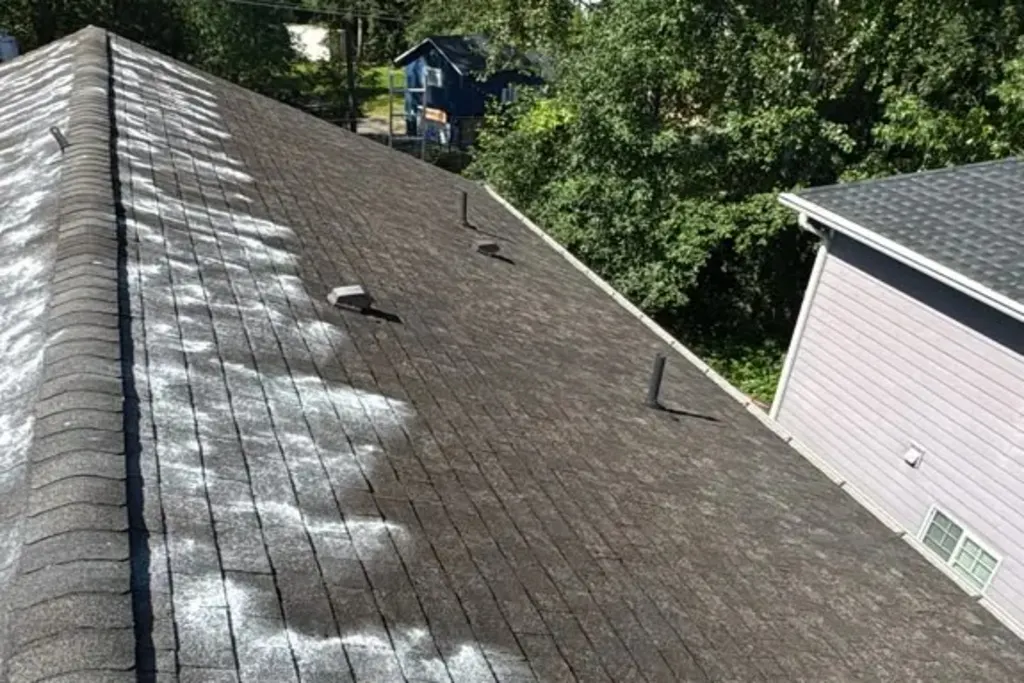
Here’s something worth noticing the next time the sun comes out after rain: which part of the roof dries last?
That section deserves extra attention.
A Lynnwood home may have one roof slope exposed to plenty of afternoon sun and another tucked beneath tall evergreens. The second area can stay damp much longer.
That’s often where you’ll notice moss first.
Look along shingle edges, around roof penetrations and near areas where branches shade the house. If one section repeatedly develops growth while the rest stays relatively clear, simply cleaning the moss doesn’t explain why it keeps coming back.
Shade, moisture, tree coverage and airflow all play a part.
You don’t necessarily need to change those conditions. You should, however, know which part of your roof needs watching.
What Is Actually Sitting on Your Roof?
Not every leaf needs immediate attention.
The concern is debris that doesn’t leave.
Fir needles can settle into valleys and bunch together. Leaves get caught behind chimneys. Twigs lodge beside skylights. Once everything gets wet, it can form a dense layer that takes longer to dry than the surrounding roof.
Look at those collection points after windy weather.
If the same valley fills up repeatedly, remember it. If leaves always gather behind the chimney, check that area more often.
Homeowners sometimes focus so heavily on visible moss that they overlook a pile of wet organic debris a few feet away.
Both deserve attention.
A Little Moss Is Still Worth Noticing
The first sign may be nothing more than a few fuzzy green spots along the edge of a shingle.
There’s no reason to panic over them.
There’s also little benefit in pretending they’re not there.
Take a picture and check the area again later. If the patch is spreading, you’ll know you’re dealing with active growth rather than an isolated spot.
Where homeowners can get into trouble is trying to make stubborn moss disappear immediately. Hard scraping and aggressive brushing can be rough on roofing materials. Walking across a damp, mossy slope creates a separate problem: staying on your feet.
If moss has become established across a sizeable area, that’s a sensible point to ask a professional about cleaning.
About That Pressure Washer in the Garage…
Keep it there.
Pressure washing works beautifully on plenty of exterior surfaces. Asphalt shingles aren’t a driveway.
Concentrated water can be too aggressive for the shingle surface, particularly when someone is trying to strip away stubborn moss. Spraying water around laps, flashing and roof penetrations also isn’t something to experiment with.
The cleaning method should suit the roofing material.
If you’re searching for “soft roof wash near me”, ask a few questions before hiring anyone. How will they handle the moss? What do they use around flashing and gutters? How do they protect the surrounding property?
Those questions are more useful than simply asking how quickly they can make the roof look clean.
Check the Gutters While It’s Raining
You can learn more from a gutter during ten minutes of rain than from staring at it on a dry afternoon.
Watch the water.
Is it moving freely toward the downspout? Is one corner overflowing? Does water pour over the edge above the front door? Is one downspout barely flowing while the others are working normally?
Make a note of anything unusual.
Later, when conditions are dry and you can safely access an appropriate section, check for leaves, needles, moss and other material that may be restricting drainage.
Also notice what’s in the gutter besides plant debris.
Some loose granules from asphalt shingles can show up over time. If you’re suddenly seeing a large amount along with obvious wear on the roof, mention it when you have the roof inspected.
The gutter is sometimes where evidence of what’s happening above ends up.
Don’t Forget the Awkward Spots
Every roof has places that are easy to overlook.
Behind the chimney is a good example.
From the driveway, everything may appear clean. On the uphill side of that chimney, though, needles and leaves may have been sitting for weeks.
Roof intersections deserve the same attention. So do the areas around skylights, vents and other penetrations.
You don’t need to climb up and clear these areas yourself. In many cases, you shouldn’t.
Just remember that the most visible part of the roof isn’t necessarily the part collecting the most debris.
While You’re Looking, Check the Flashing
A roof isn’t made of shingles alone.
Metal flashing helps manage water where roofing meets a chimney, wall, skylight, vent or another transition. These areas aren’t very large, so they’re easy to miss during a casual look from the yard.
See something bent?
Take a picture.
Notice metal pulling away near the chimney?
That’s worth having checked.
The same applies if an area around a vent suddenly looks different after a storm.
Trying to diagnose the exact problem from the ground isn’t necessary. Identifying that something has changed is enough.
After a Windy Night, Check Again
Roof maintenance doesn’t need to happen only on predetermined dates.
Weather gives you another schedule.
Following strong winds, take a quick walk around the house once it’s safe outside. Look for branches, newly accumulated debris and anything on the roof that seems out of place.
Then look down.
If you find a piece of roofing material in the yard, don’t automatically assume the worst, but don’t toss it away without looking at the roof either.
The whole check might take five minutes.
That’s often enough to catch something you wouldn’t otherwise notice until your next seasonal inspection.
Sometimes the Problem Is Above the Roof
Look at the tree canopy.
Are branches resting against the roof? Is a dead limb hanging above it? Does one evergreen constantly drop needles into the same valley?
Nearby trees don’t automatically cause roofing problems. They’re simply part of the environment around the roof, and their position affects how much debris and shade certain sections receive.
Reasonable trimming can help when branches hang directly over the house.
Large or difficult limbs are a job for a qualified tree professional. Trying to cut them while standing on the roof creates far more risk than the debris you’re trying to prevent.
Roof Cleaning in Lynnwood Doesn’t Follow One Schedule
You may hear that a roof should be cleaned every year, every other year, or according to some other fixed timetable.
Your property may have different ideas.
Picture two neighboring Lynnwood homes. One sits in an open lot and receives good sun for much of the day. The house next door has several mature evergreens shading the roof.
Even if both roofs were installed at the same time, they may not accumulate moss and debris at the same rate.
Instead of cleaning solely because a date has arrived, look at:
- tree coverage around your home
- recurring moss growth
- shaded roof slopes
- debris collecting in valleys
- gutter buildup
- how quickly the roof dries after rain
- the condition and age of the roofing material
For many homeowners, a ground-level check in spring and another before the wetter months is a useful habit. Add an extra look after unusually rough weather.
What you see should help determine what happens next.
There Are Some Jobs You Don’t Need to DIY
Seeing debris on the roof and being able to reach it safely are two different things.
That’s particularly important around moss.
A roof that appears only slightly damp from the yard can be surprisingly slick underfoot. Add slope, loose debris and a ladder to the situation and a simple cleaning job can become risky very quickly.
There’s no reason to prove you can do it yourself.
Stay on the ground when the pitch is steep, the surface is wet, or the problem sits somewhere difficult to reach.
Professional help also makes sense when moss covers a large area, shingles appear damaged, flashing looks questionable, or you’ve noticed possible signs of a leak.
If you’ve reached the point of searching “roof cleaning near me Lynnwood”, focus on finding someone who will look at the condition of the roof rather than treating cleaning as a cosmetic job.
What Should You Remember From This Checklist?
You don’t need to memorize ten maintenance rules.
Remember the spots on your house.
Maybe the north-facing section grows moss first. Maybe needles always pile up beside the skylight. Perhaps the gutter above the garage is the first one to clog.
Those patterns are useful because roofs rarely change uniformly.
When you check your property, ask yourself:
- Is there more moss than the last time I looked?
- Has debris collected somewhere it normally doesn’t?
- Are the gutters handling rain normally?
- Does any shingle look out of place?
- Has anything changed around the chimney, vents or skylights?
- Are branches getting too close to the roof?
If nothing has changed, good.
Take another look in a few months.
If something has, photograph it and keep an eye on it or arrange an inspection when appropriate.
A Few Questions Lynnwood Homeowners Often Have
Why does moss keep appearing on only one section of my roof?
That part of the roof may receive less direct sunlight or stay shaded by nearby trees. It can remain damp longer than other slopes, creating better conditions for moss.
Does a dark roof stain automatically mean I have a problem?
No. Roof discoloration can have several causes. If a stain is new, spreading, or accompanied by other changes, have the area evaluated rather than guessing from appearance alone.
Can I brush moss off the shingles?
Aggressive brushing or scraping can be hard on roofing materials. There is also the safety issue of working on a mossy roof. Established growth is better handled with a method appropriate for the roofing material.
Why check gutters if I’m concerned about the roof?
Because roof debris often ends up there. Gutters can also show whether water is leaving the roof properly. Overflow in one location may point you toward an area that needs attention.
Do I need professional roof cleaning every year?
Not every home does. A shaded property surrounded by evergreens may need attention sooner than an open, sunnier property. Let the amount of moss, debris and buildup help determine the timing.
Your Roof Doesn’t Need to Look New. It Needs Attention at the Right Time.
A few needles won’t ruin a roof. Neither will one tiny patch of moss suddenly turn into a major roofing problem overnight.
What matters is what happens over time.
That pile of needles is worth another look if it’s still sitting there weeks later. The moss deserves attention if it’s spreading along the shingle edges. And a gutter that overflows every time Lynnwood gets a hard rain is telling you something.
Paying attention to those changes makes roof maintenance much simpler.
If moss or debris has built up beyond what you can safely manage, Skilled Roofing provides professional roof cleaning in Lynnwood. Our team can clean the roof using an appropriate approach and check visible areas that may need further attention.
Call 425-737-7760 to schedule roof cleaning or an inspection.